Denise Marotta LopesDenise Marotta Lopes

Encouragement. Hope. Without exception, love.

Stories

A Chosen Friendship

by Denise Marotta Lopes on Jun 22, 2021 category Stories

Friendships don’t blossom out of nowhere. It had been my experience that they developed out of proximity, shared interests, good fortune. It was rare to choose a lifelong friend, but, choose, I did, on a Sunday morning in 1998.

Our family had just moved to a small mountain town in northern New Jersey where I knew no one outside of my home other than the realtor who had sold us the house. My husband had been transferred to a nearby office, my children were starting school, and, soon I would be alone in this unfamiliar environment where it was not uncommon to see a black bear at one’s bird feeder.

We explored the new town: the antique stores, the library, the ice cream shop near the lake, the coffee shop on Main Street. I felt like a visitor, passing through on her way elsewhere. We attended a number of churches, but hadn’t found one that felt like home until we landed at the little white church across the street from the coffee shop.

My family of four sat toward the front nearest the windows. Still feeling disconnected, I looked to the front of the church for something to anchor me: the familiar cross, the keyboard, the pulpit. The worship team walked out, testing the microphones, checking in with one another about songs and whatever it is that people discuss in whispers. It was then that I saw her.

She had blonde hair, an attractive smile, and an effervescent personality that made it hard for her to stand still. She was part of the team, and yet, she seemed uniquely independent. When the music started, she began to sing, and her voice was like that of an angel—a gritty, accessible, free-flying angel. I was certain that if this were 1969, the woman would have been at Woodstock. I knew I had to meet her.

After service, I tried approaching her, but she was surrounded by people. I waved, nodded my head in an appreciative manner, and politely bowed out. I thought about her all day. That blonde woman.

In the early evening, my husband and I took our children to a small neighborhood lake. While they played in the sand, he and I sat on a bench near the water. Waves of sadness were beginning to wash over me—feelings of not belonging. Lost in my thoughts, I looked out onto the water. From across the lake, an object came into focus, a rowboat gliding in our direction. It was a comforting site, a slow, methodical movement across the sun-drenched water. As the boat got closer, I noticed there was one person inside, steadily rowing, rowing, rowing. It was the woman with the blonde hair.

She pulled up to the dock, wrapped the rope around a cleat hitch, and walked over to a nearby bench. With a rapidly-beating heart, I said hello, and when she seemed approachable, I introduced myself, telling her how much I had enjoyed her singing that morning. Her name, I learned, was Cathy.
We spoke for over an hour—eventually sharing one bench. I generally take my time with new friendships, assessing their reliability before sharing too much of myself. But, she and I trusted one another immediately. There was a heart connection that allowed us to both speak and listen. In the early days of our friendship, our conversations revolved around raising school-aged children. Through the years, those conversations evolved to deeper matters of mothering adults, and nurturing grandchildren. We have allowed ourselves confessions without judgment, admissions without explanation Always there was room for our own interests and the sharing of dreams, paint colors, gardening tips. There were tears, and always raucous laughter.

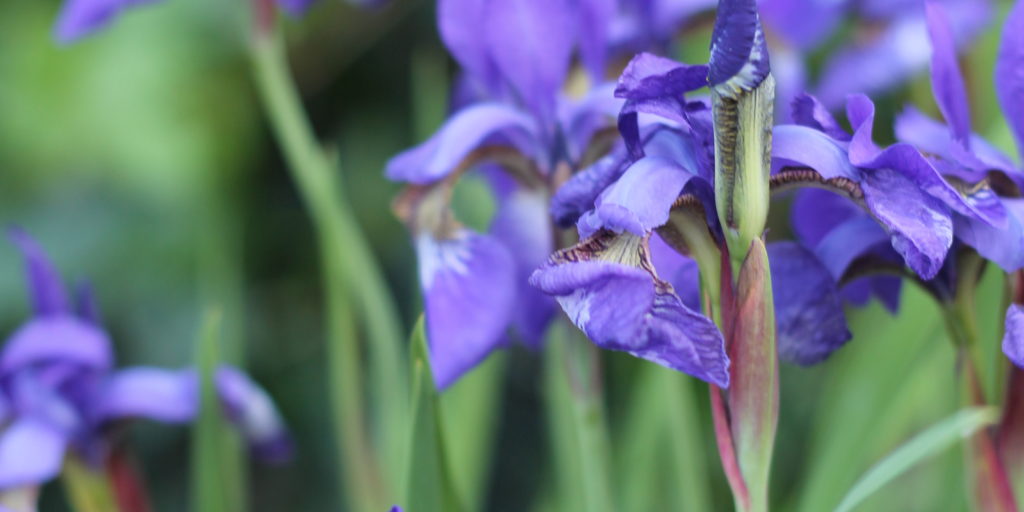
After eight years, our family moved to Maryland and eventually to Delaware; Cathy remained in New Jersey. Distance was never a deterrent to our friendship, no matter the miles. Sometimes we’d meet halfway and spend the day shopping and having lunch in New Hope, Pennsylvania. In summer we’d meet at the Jersey Shore. We’d visit in each other’s homes. She’d share irises, wild geranium, astible, purple coneflower, black-eyed Susan, and primrose from her garden, and I’d plant them in the soil of my new home.

Though much has changed over the 23 years of friendship, what remains is our love for one another.. What continues to grow from the roots we established on that park bench on a lake in a mountain town in northwestern New Jersey, are the strong branches of a well-established friendship, and the blossoms of shared hopes and experiences. I am reminded of the choice I made while sitting in that little white church on a Sunday morning, and I am forever grateful.
Grandma’s Elusive Apple Cake

by Denise Marotta Lopes on May 18, 2021 category Stories

Growing up as I did in the 1970’s, home cooking was the norm; eating out was the anomaly. Unless you counted Friday nights at McDonald’s, or breakfast at the pancake house after First Holy Communion, meals were served at our rectangular Formica kitchen table. Accompanied by wooden chairs that we dragged across linoleum floors, it was my family’s gathering place.

In our home, Mom was the recipe-follower. She taught me to cook and bake by adhering to precise measurements. If the recipe called for a teaspoon of cinnamon, she used a teaspoon of cinnamon. The only variant she allowed herself was to add a dash of nutmeg to her crumb cakes and pumpkin pies. She is nearly 85 years old, and still does not deviate from this method. There is no need to try something new and ruin an entire batch of cookies with all that butter in there, when you could just follow directions.

Her recipes are written down, some on scraps of paper stuffed into backs of old cookbooks, others on index cards, still more in a green, flowered three-ring binder. A smaller notebook is only for Christmas cookies. Some she’s transferred to her computer, making it easier to share with friends. Many of these same recipes are on index cards in my wooden recipe box, written in my young hand, or in my mother’s original script: bracciole; corned beef and cabbage; date nut bread; deviled eggs; goulash; Irish soda bread; Italian meatballs; lasagna; pasta e fagioli; sausage & peppers. When I married, my husband and I sat down to meals suitable for six; all of my recipes were for my family of origin—Mom, Dad, my two brothers, one sister, and me.

Dad had his own method of cooking. He opened the refrigerator and created something out of whatever he saw in glass containers or Tupperware bowls. Leftovers were never just leftovers. Instead of simply using up the old, he created the new. A random carrot, a stalk of celery, a hunk of ginger, a piece of meat along with an onion, spices, and soy sauce became essential ingredients for fried rice. Consequently, asking him for a recipe was an exercise in futility. If I wanted to know, I had to watch. If I asked him how long to cook something, he’d respond, “Until it’s done.”

Mom’s mom didn’t write down recipes either. Instead, Mom observed and asked questions. Then she wrote. The one recipe she never did obtain, however, was for my grandmother’s apple cake with warm lemon sauce. Grandma made it in a yellow enamel 8 x 8-inch square pan. It was a small cake, narrow in depth, not necessarily dense, a little light. Grandma would peel an apple picked on a trip to upstate New York. Her favorite was Macintosh, but she used any apple she had. She’d stand over the cake with the apple and slice it right there with a fruit knife, placing the slices on top of the cake and pushing them down into the batter just a little. When it was still warm from the oven, she sliced the cake and placed a piece on each of four plates: one for Mom, Uncle Bobby, Grandma, and Grandpa Sparky. Each person poured hot lemon sauce—as much as they wanted—on top. There were never leftovers. Everyone loved that apple cake. “Even my father,” Mom said.

Over the years, my mother tried to duplicate this recipe. Even when my grandmother was still alive, yet no longer cooking, Mom would bake an apple cake using a recipe she found. She would bring it to my grandmother, who took one look at it and made a face. Mom would say, “Just try it.” Grandma took one bite and said, “That’s not it.”

I have two of my grandmother’s cookbooks which mom and I have scoured for that apple cake recipe. We found some which Mom has tried, but to no avail. The last time I visited Mom, she said she found a new recipe for apple cake which she is going to try. This one called for salted butter and she never uses salted butter in her baking recipes. Maybe the salt is what gives it the right flavor. She’ll try. Yet again.

I wonder if what makes a recipe special is its connection to the person who made it. Taste is memory. It is experience. It is love. It is a reminder of those who have gone before us. It is what keeps my mom trying to find an apple cake recipe like the one her mother made. The one that brought her whole family together in the kitchen until every last crumb was eaten. Maybe Mom will never be able to duplicate Grandma’s apple cake because it is not made in their kitchen on Lake Avenue in Yonkers, in that yellow pan, with apples from Upstate. Yet she’ll continue to try. And, hope.

Welcome Home

by Denise Marotta Lopes on Apr 20, 2021 category Stories

I was nine years and three days old. There were only two months left in the school year when my family left the bustle of city life to move to the suburbs.

Yonkers had been my home. In the city, the whole world was right outside my door. My friends were around the corner; my school and church were across the busy McLean Avenue which separated Yonkers from the Bronx. The park where my siblings and I played was adjacent to the school. Everything was a walk away: Boehringer’s Bakery with its jelly doughnuts sprinkled with real sugar; Nick the grocer where I bought ricotta cheese for my mother, and stuck my finger in the bag on the walk home to taste it its creamy goodness; Mr. Blackman’s candy store which once had a fire and his Cocker Spaniel, Blackie, had died.

It was a noisy, hectic world, but it was my world.

When I was told we would be moving, I was uncertain. I knew we’d be living near my cousins, and that was fun. But, I’d be leaving all my friends, my school, my apartment at the top of the flight of 16 stairs, my church, and most especially, my grandma.

It was raining on moving day. I don’t recall the truck packed with our belongings or even the two-hour drive down the New Jersey Turnpike to Exit 5. I remember the anticipation as we exited and drove on the country roads of this unfamiliar place. I knew my Aunt Mary and Cousin Anne were waiting for us at the new house. I remember the drive down the street and looking out the window of the car, over the heads of my younger sister and brothers.

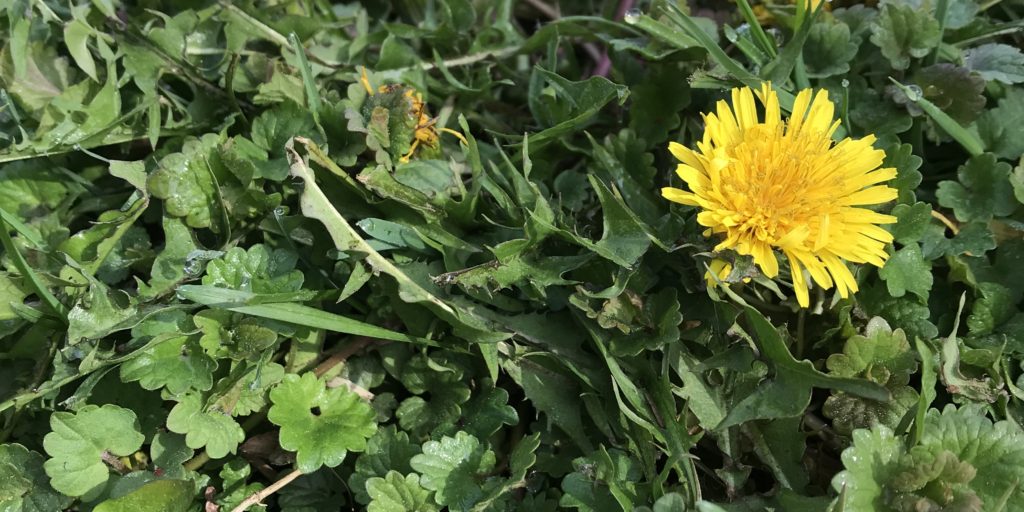
The car slowed halfway down the street, and my dad pulled over in front of a two-story colonial home. It was painted gray with light pink shutters. I thought it was so big. But, more than that, what immediately drew my attention, was the lawn. The grass. And, the flowers. The yellow flowers. I remember calling out the beauty of those spectacular flowers.

Those flowers, I learned, were dandelions. Common weeds. Invasive weeds. But, to my nine-year-old self, they were a wonder. I did not see them as something to eliminate, but rather, something to treasure. They were, in fact, my welcome home.

In the Eyes of a Child

by Denise Marotta Lopes on Mar 1, 2021 category Stories

When I was a little girl, I thought that tonsils were long toothpicks that resided in the stomach. I have no idea where I got that impression, but there was no talking me out of it. As I’ve gotten older, I’ve had an especially keen appreciation for the ways of children, and of how they see the world. Of what they hear and of what they believe. I wonder what conclusions they’ve come to.

Rockland is my link into that world. I could listen to him talk all day. I have to squelch my desire to write it all down for fear of missing even one word.

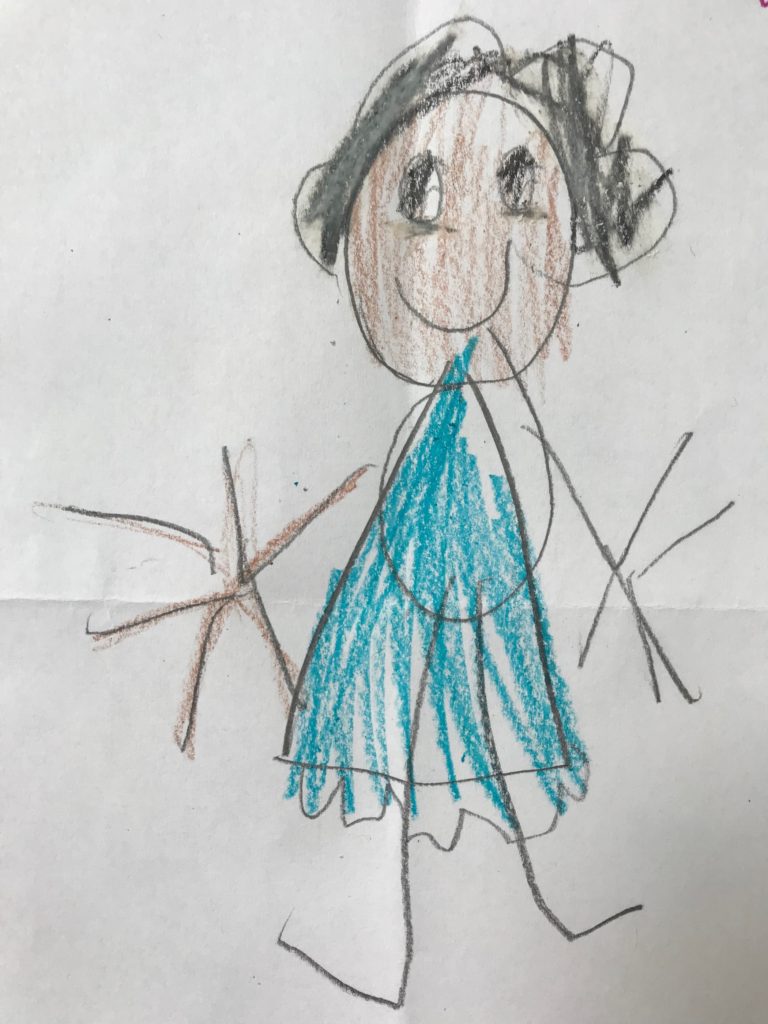
Recently, one of his kindergarten classmates was missing her grandmother, who had died only the week before. She had heard Rockland speak about me in class, and decided she would draw a picture of me, and asked Rockland to give it to me. But, first she needed to know what I looked like.

I didn’t even know she was drawing a picture of you and then she came over to my desk and I told her what you were like.

Oh.

I said you had a blue dress. And you have curly hair. Black.

Awe! My favorite color is blue! I see some gray crayon in there, too. Did you tell her I had gray hair?

Yes, and I told her about your face—that your skin was brown.

How sweet.

I also told her she should draw a little bit of some glasses—an eyeball and then a lens.

Okay.

This portrait, drawn by a five-year-old I’ve never met, hangs on my refrigerator. It depicts her heart—the one that longs for her own grandmother. It is also a reminder to me of how I’m seen through the eyes of that little boy. I’m glad he included a smile.

Now, I’ll have to buy a blue dress.

Friday Fun with Five-year-old

by Denise Marotta Lopes on Feb 15, 2021 category Stories

There’s something about Friday that conjures up a pause from the routine and opens a door to something new and exciting. In my earlier years, it was a sleepover at a friend’s house or a Friday night high school basketball game. Later, it became meeting up with friends or attending a party with co-workers. Now, it means picking up my grandson from kindergarten.

I pulled up to his school in anticipation. I parked the car and began walking from the parking lot to the playground where I spotted him in his brown Carhartt jacket. He was wearing blue sweat pants and a green “Elf” t-shirt underneath—his choice for “mismatch day”. His mask with the school insignia floated just below his nose.

There were two adults on duty and I told one that I was there to pick up Rockland. She called to him and when he saw me he stopped playing with his friend, ran over at full speed, and wrapped his arms tightly around my legs. Nonna! I hugged him and told him how happy I was to see him. I asked him who his friends were and he began to name each child, adding important details I should know. As he spoke, the other adult came over to greet me; Rockland’s words began to get swallowed up in his mask and the sounds of the children and I wanted to kneel right next to him so as not to miss a single one.

I showed my identification and waited outside the school door while Rockland and the adult went inside to gather his belongings. Soon he reappeared and handed me a baggie with little Valentine’s hearts inside. You can peel off the back and stick them onto a card if you like, Nonna. He informed me that I could carry his water bottle and lunch bag, as he slung his backpack over his shoulder and we headed to the car.

My 14-month-old lab, Ivy, was waiting for us on the front seat. As I opened the back door to let Rockland in, she hopped over the console and right out the back door, overcome with excitement at seeing her favorite five-year-old. I caught her by the collar as Rockland climbed up and buckled himself in. I got Ivy settled and then began the 25-minute ride back to my house.

He started right in on the red Gala apple I had waiting for him, chewing it down to the pits. Look at this, Nonna! There was a bag of popcorn, too, but he informs me that he prefers his popcorn hot. He entertains me with his conversation, pointing out things I would have driven by with little notice. We don’t stay on any one topic for long. Somehow we landed on school rules and I was interested to hear some of them: no wrestling to the ground; flush the toilet and wash your hands; and no squishing your friends when you sit down.

We pass the street that leads to President Joe Biden’s house and I point it out to him. Can we see his house? I tell him we are not allowed to go there. Oh, you can only go that way if you live in that neighborhood? Correct.

We continue on, keeping up with the flow of Friday afternoon traffic. Finally we reach my street and I back into the driveway. When the car stops, he swings the door open, dashes out, and runs toward the side door. I wrangle Ivy, backpack, water bottle, lunch bag, apple core, napkin, and nearly-full bag of popcorn. When I enter the house, I hear Rockland asking Papa if he wants to play soccer in the basement. Papa tells him he’s still working, but maybe in a little while.

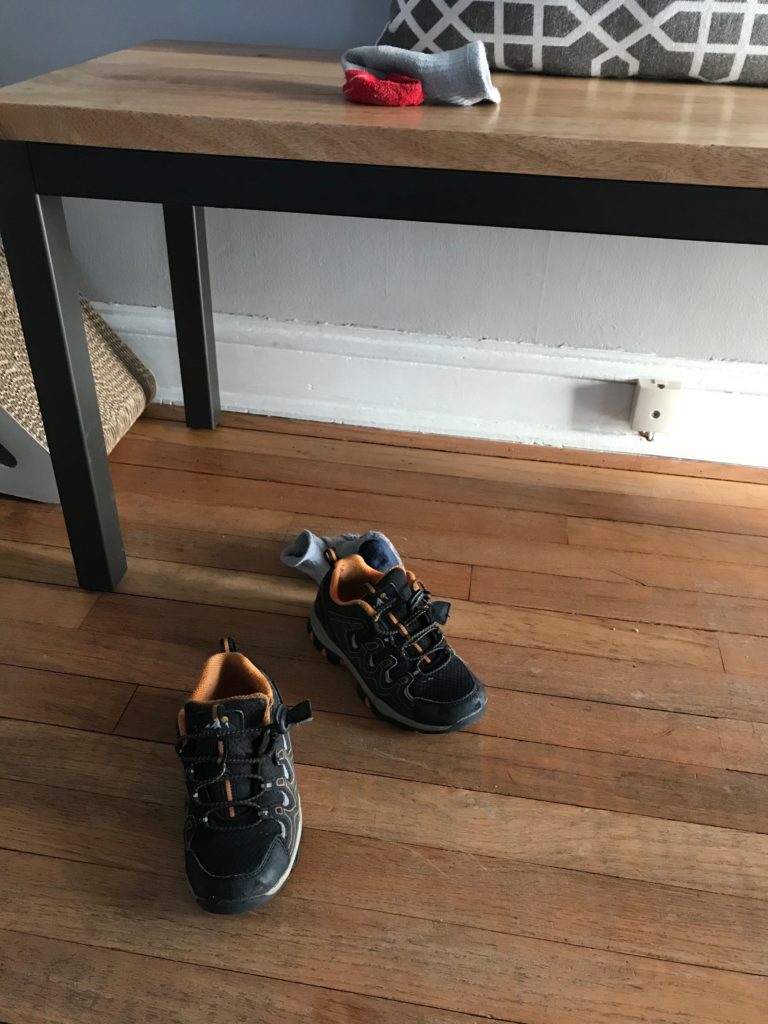
His shoes and socks are already off and flung to the ground in the living room. He proceeds to the guest room/office, the one he calls his room, the one that he graciously shares with me. I help him open the closet that holds his toys and stuffed animals. I am awed by his ability to move so quickly from one thing to the next.

He plays, he eats, he grabs a book, he lifts weights, he throws the suction-cup ball against the wall to see if it sticks. He shows me how to use the voice command on my remote. Nonna, you press this button and say, ‘Santiago of the Seas’. I suggest we read and he runs to the shelf to pick his favorite book, No, David! We take turns being teacher. I go first. He gathered six or seven stuffed animals to the chair to join him for the story. They cover him and I have to remind the animals that we don’t squish our friends. I read two pages before Rockland raises his hand, telling me that the stuffed hot dog has to go to the bathroom. I ask if it’s an emergency. It’s an absolute emergency!

Papa comes up from downstairs and we tag-team so I can get dinner started. Rockland requests oatmeal. Oatmeal it is, then. He used to help me cook. Now he tells me I can do it and goes off to play with Papa. He eats his oatmeal with butter, cream, and maple syrup. He uses the knife to cut a big hunk of butter and watches as it melts in the warm oatmeal. He pours half & half from the little doggie creamer and I help him with the quart-sized jar of organic maple syrup. He adds an ice cube so it won’t be too hot, and then gives one to Ivy. He also grazes on two bananas, some raisins, and a bowl of blue chips.

Hey, Nonna, let’s watch the Phillie Phanatic. I pull up his favorite YouTube video, the one in which Tommy Lasorda and the Phanatic get into a fight before the game. We laugh heartily. We watch some more Phillies highlights. Hey, Nonna, why are there real people at the game?

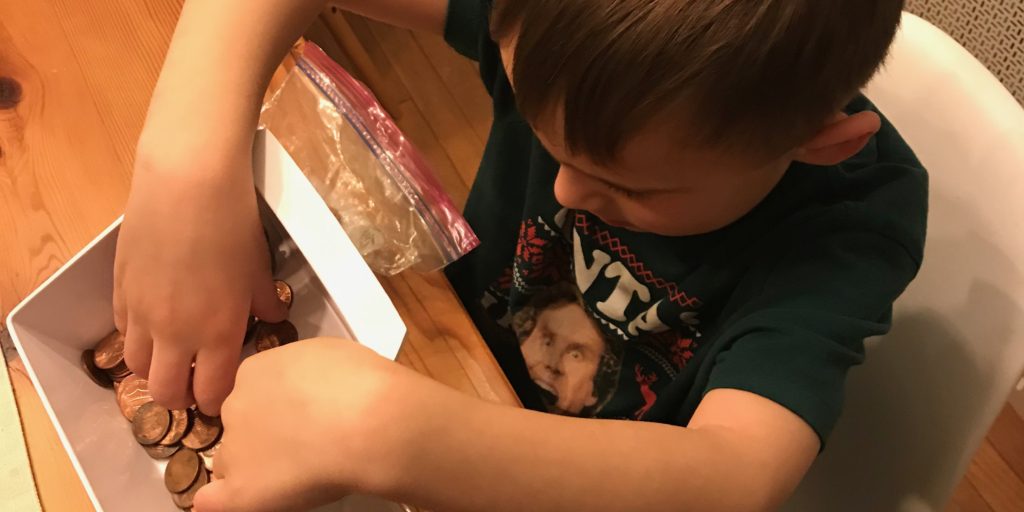
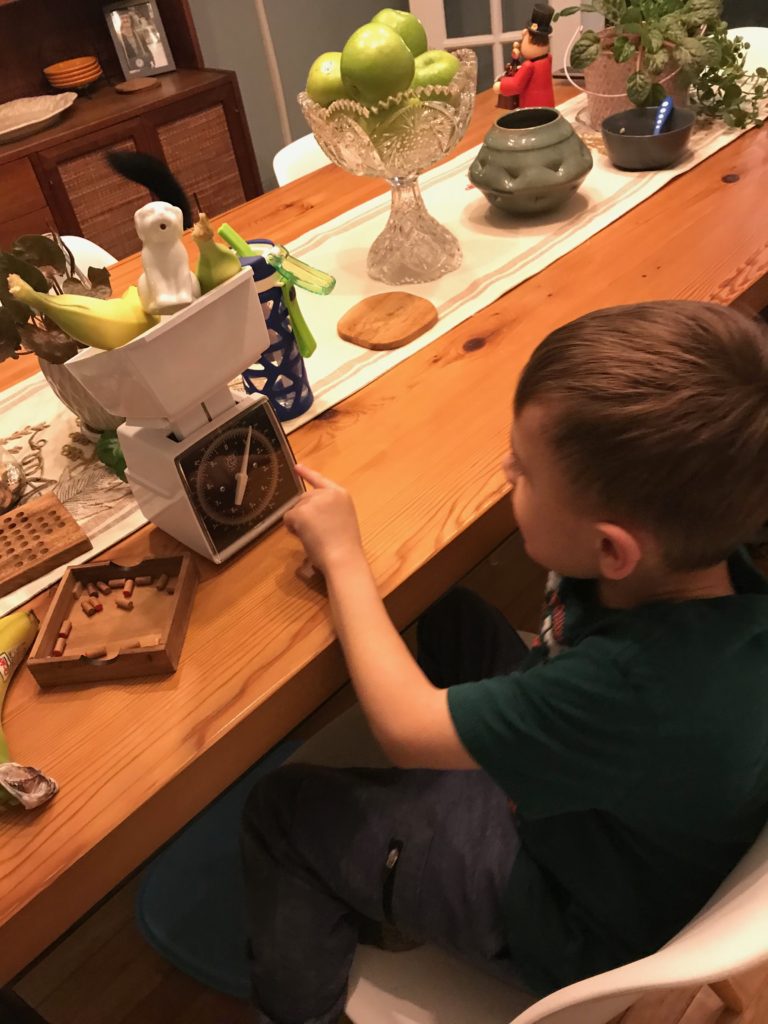
He discovers a manual kitchen scale that belonged to my mother-in-law; I use it more as a decorative piece than as a measure of weight. He pushes down on it, noticing how the dial moves with his pressure. I bring it to the dining room table where he begins to pick up a banana, the dog creamer, and game pieces and adds them to the container that sets on top of the scale. I fetch a bag of pennies that I used for math tutoring when I still met with my students in person. He began adding those, as well. He estimated which items would equal a pound, and then proudly told us to look when he achieved his goal.

My daughter texted that she and her husband would arrive in 20 minutes to get Rockland. (It makes for a more peaceful transition when he knows it’s almost time to go.) When they came in, he quickly hid himself under a blanket on the couch, and we said that he already left. Angela pretended to sit on the blanket. I’m right here!

We said our goodbyes and when he was safely buckled into his booster seat, I realized he had left without the small bag of blue chips I packed for his ride home. I quickly retrieved them and handed them to my son-in-law before they drove away. He rolled down Rockland’s window so he could talk to me.

Nonna, do you think you could send me a post? And, can you put a picture of yourself in it in case we don’t see each other for a while?

I can’t think of a better way to spend a Friday afternoon and evening than with him. Oh, this little boy.

Newsletter

Enter your name and email to subscribe and you'll receive updates in your inbox.

The Ring

by Denise Marotta Lopes on Jan 22, 2021 category Stories

This Christmas was unlike Christmases of the past. There would be no celebration this year with siblings, nieces, and nephews. No overflowing stockings; no seven fishes; no trays of Mom’s cookies. At least not for me and my extended family.

Instead, Mom and I would celebrate together, just the two of us in the home she shared with my Dad before he died nearly five years ago. We would meet on a Wednesday as we have done weekly for more than two years. We would sit at her kitchen table and have lunch. She would tell me stories of her childhood, of the early days with my Dad. I would have coffee; she would have tea.

This Christmas, it was I who filled my car with gifts from those who were unable to come to Mom’s due to health concerns with COVID-19. It was I who played gift-giver, handing her one package after another with an explanation of its giver.

We listened to Johnny Mathis Christmas songs on her new CD player. We reminisced about my grandmother and her husband, Allie, who would pile gifts into their 1970s gold Gran Torino and drive the two hours down the New Jersey Turnpike to spend Christmas with us when we were young. To my siblings and me, she was our Santa.

In those days my mother would tell us that we wouldn’t be getting a lot for Christmas because things were tight. And, yet, we always had enough—in fact, more than we could ask for.

When Mom handed me my Christmas bag this year, I already knew what was inside. I had picked out a special pair of ergonomic gardening scissors with a shiny white handle; I pretended to be surprised as I unwrapped it. In the bag there was also a card with cash so I could pick out another gift later on. I returned the scissors and card to the bag when she said, “There’s something else in there.”

I looked up. “There is?”

I reached past the tissue paper and crumpled wrapping to the bottom of the bag where I found a small nondescript box.

“What is this?” I asked.

Mom sat quietly, smiling. I unsnapped the box and lifted the lid.
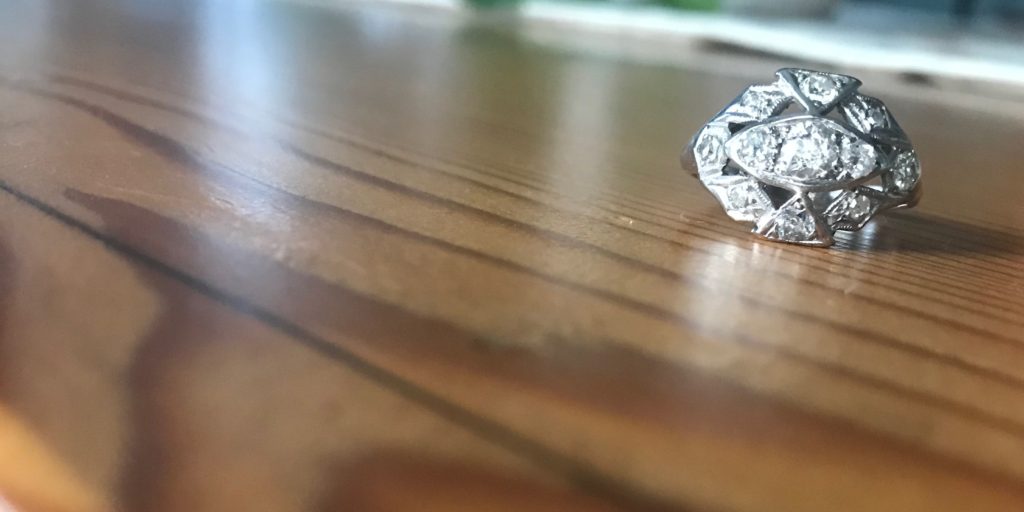
Inside, was a silver ring. It was art-deco-inspired with geometric settings of triangles surrounding an edged oval in the center. There were diamonds inlaid in each of the shapes.

“Grandma’s ring!” I exclaimed.

Across the kitchen table, I looked at Mom, and she at me. My eyes returned to the ring as I held it up, imagining it on my Grandmother’s finger. In that moment I heard her raucous laughter, saw her red hair, bright lipstick and blushed cheeks. I felt the excitement of a little girl sitting around the family table playing penny poker in our kitchen. It was always a holiday when Grandma came to visit.

Mom shared that her mother had the ring made from my Great Grandpa Tony’s diamond tie clip. Mom remembers her grandfather as a man who always wore a suit. I remember him as one with a ruddy complexion, bulbous nose, deep, gentle voice, and thick white wavy hair.

Grandma originally had the clip attached to a ring she wore until the diamonds began to loosen and she consulted a jeweler to obtain one with proper settings. I wonder how she felt as she chose the style. I wonder what she remembered about her father as she considered the gift he had left for her.

I slipped the ring onto my finger. I held it in place to keep it from sliding and tried to see it as mine, though it still looked like hers. Maybe it belongs to both of us now. Maybe to all three of us, as it was my mother who passed it on to me. And, one day, I will pass it on to my daughter.

I showed it to my grandson and told him the ring had belonged to his Great Great Grandma Peggy. Sometimes he adds an extra “Great” when saying her name. That would certainly be apropos.

The ring was fitted to my smaller finger. I wear it remembering what came before and what is still to come. And, I am thankful for a legacy of love captured in this shining gift.

Everyone’s Aunt Lucy

by Denise Marotta Lopes on Aug 13, 2020 category Stories

When my Uncle Charlie brought his future bride to meet the family, she wore a leopard pillbox hat with a matching bag. Stylish, yet understated, Aunt Lucy made an impression on the family, especially on my then-teenaged-father, who for years after, reminded her of that first meeting.

As a child, I remember her remarking on my height, looking upward and saying I was growing like a weed. Many call her Aunt Lucy—including my sixteen cousins on my father’s side alone. She addresses us using our given names. Her son, she calls Daniel; my brother, Joseph; my son, young Joseph. She has a quiet grace and thoughtful manner. She has strength she is unaware of and speaks simple words that carry weight.

Aunt Lucy listens more than she speaks, uttering sounds of acknowledgement with a slow nod of her head. Due to her quiet manner, some might mistake her for naive; but as her son, Danny, noted, “You don’t live 96 years and not know stuff.”

She lives with my cousin Jo Anne and her husband, Vince, near Charleston, South Carolina. Aunt Lucy’s second-floor bedroom has a porch where she often sits to read, pray, and nap. From her vantage point she is able to see a wooden porch swing in the park across the street. Her daughter, Marguerite, said, “For the last five years she has been eyeing the swing on the green.”

Several months ago, Aunt Lucy was in her upstairs bedroom when she suffered a stroke. Jo Anne noticed the signs and immediately called for an ambulance. When the emergency medical team arrived, they discussed how to get a stretcher upstairs. Recognizing the difficulty, one of the team asked how much Aunt Lucy weighed, and as Marguerite describes, “The fireman carried her down the stairs as if she were a young bride.”

She was put on a stretcher and wheeled out of the house and onto the walkway leading to the street. Lying on her back, she was able to see the sky, the trees, and the windows of her neighbors’ house. She spotted two young children looking down at her.

“They looked so sad and frightened,” she said. “I was able to lift my hand and wave to them so they’d know I was okay.” Jo Anne later described the act as “the queen mother waving to her subjects.”

Aunt Lucy’s recovery was long and arduous. Due to COVID-19 she was not allowed visitors; the nurses and doctors became her connection to the outside world through their bedside chats.

“How old are you?” asked one of the nurses.

“I’m 96.”

“You are?”

“Yes, I am,” Aunt Lucy responded.

“You don’t look 96.”

“Look closer.”

The days ahead were difficult, but my aunt worked hard at her physical therapy, hoping she would soon be strong enough to return home. The day finally arrived and she was able to once again be in her own room with her family nearby. Physical therapy continued. She forced herself to eat in order to gain strength. She continued to sit on her porch and look out at the park, and in particular, at the wooden swing.

One day, while her daughter, Marguerite, and granddaughter, Krysta, were visiting, Aunt Lucy said, “I wish to go on the swing.”

Marguerite said, “Come on, Mom. Let’s go.”

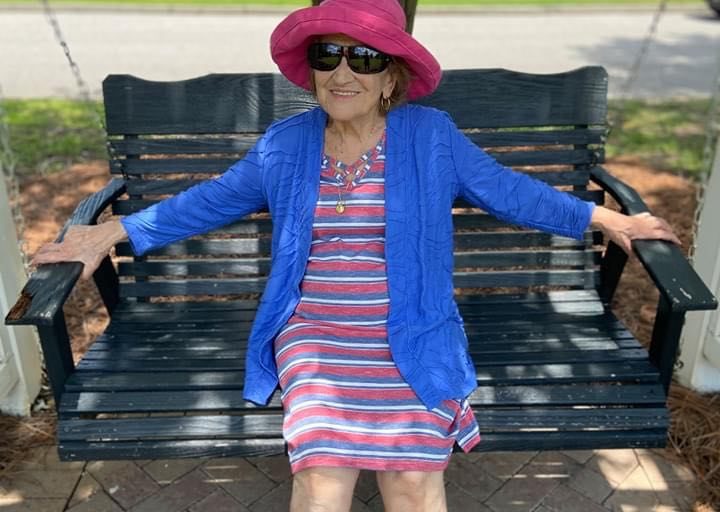
The walk was slow—one tiny step at a time—out the front door, across the street, into the park, and onto the paver stones. With help, she was positioned onto the middle of the swing’s wooden planks. Bracing herself by holding onto the arm rests, she gently pushed off with her feet, and began to sway—back and forth. Behind her large black sunglasses, I imagine her eyes closed in the wonder and freedom of the movement. Her smile lit up the space. Dappled sunlight fell upon her striped dress, blue cardigan, pastel pink socks, and soft-soled shoes. On her head she wore a fuchsia wide-brimmed sunhat. I suspect it will be a day remembered with fondness.

Photo credit: Krysta Vidakovich

A Mom to the Rescue

by Denise Marotta Lopes on Jul 31, 2020 category Stories

My mother-in-law was a slight woman with a movie star voice. Born the third youngest of eight children, she learned early to speak up for herself. In families that size there was often a line of demarcation between the older and younger siblings (the older ones assigned as “guardians” of the younger ones by over-worked parents).

On her first day of kindergarten, my mother-in-law entered the classroom as Leonora, and left with the Americanized-version of Eleanor. Growing up, her job after school was to come straight home and sweep the whole house. One day she took a break to read a book when one of her older brothers caught her and said, “Put that down and get back to work!”

She glared at him before shouting, “You’re not my father!” But the message stuck, and for the rest of her life, she never again picked up a book purely for pleasure.

In 1954 she married my father-in-law. In the years that followed, taking care of her own family would become her life’s work. She ironed twenty shirts a week: five for her husband and fifteen in total for her three sons who attended Catholic School. She danced with her neighbor, Josie, to Italian folk songs playing on the radio in her suburban kitchen. She made escarole and beans on Friday nights and codfish cakes on Christmas Eve. She stirred her husband’s coffee before serving it to him after supper. She enjoyed her red wine.

She was the mother of a three-and-a-half-year old son when the twins were born (I am married to one of those twins.) One night, she tucked Joe and Jon into their shared doubled bed and turned out the light. But, instead of falling asleep, they discussed the evil cartoon character, Max the Nose. Hearing the boys’ chatter, my mother-in-law returned to their room.

“Why are you not going to sleep?”

My husband spoke for the two of them saying, “Max is underneath the bed.”

Anger rose inside of her, but the anger was not directed toward her young boys.

“Oh, yeah? Where is he?”

Joe pointed under his side of the bed.

“Right here, Mom.”

With long, purposeful strides she made her way to the bed, reached under and grabbed the little monster.

“All-right,” she announced. “I’ve got him now.”

With her fist tightly-clenched around the monster’s neck, she stomped to the window, lurched it open, and threw him out.

“He won’t bother you anymore. So, now it’s time to go to sleep.”

And, with that, her young sons were satisfied. No longer afraid, they breathed sighs of relief and fell to sleep. Max was gone.

My mother-in-law may have lived a simple life by some standards. But, in the eyes of two frightened little boys with a monster under the bed, she was a full-fledged hero.

My Dad’s New Clothes

by Denise Marotta Lopes on Mar 23, 2020 category Stories

My dad grew up the seventh son of a seventh son. He and his eight brothers and one sister lived in a small railroad apartment in Brooklyn. They were poor. So poor, in fact, that Dad said they couldn’t afford grandparents. Nevertheless, they were happy.

My grandpa Rocky, a war veteran, belonged to the American Legion. Each summer the men chose local boys to attend an overnight camp in New Jersey. My dad had never been to the country, so when he was told that he and his brother, Rocky, were going to camp, he was elated!

Grandma Josephine bought them some new clothes to wear and packed their suitcases. After the long, steamy ride on the bus, they finally arrived at camp. It was exciting for the boys from Brooklyn to be so far from home and in such a beautiful place.

After a full day, some of the campers decided to take a swim in the lake. Dad chose instead to get washed up and dressed for dinner. He was anxious to put on the new suit that his mother had packed for him. When he was alone, he carefully removed it from his case, taking care not to wrinkle it. He scrubbed up, brushed his hair, and got dressed. He felt so proud to be wearing new clothes. Having so many older brothers, he usually wore hand-me-downs. Oh, this suit was something special! It even had pinstripes and piping all around it.

Dad proudly walked out into the camp area to wait for the boys to come back from their swim. After a short while, two of the guys started walking toward my dad. “Hey, Joe, what’s the matter? Don’t you feel well?”

Dad replied, “Sure I do. I’m fine.”

A few minutes later some more of the boys came back. Again, Dad was asked if he felt okay. He replied affirmatively.

Finally, brother Rocky returned, and when he saw Dad, he looked very concerned and asked, “Hey, Joey, what’s wrong with you? You sick or somethin’?”

By now, my father was very perplexed and beginning to get annoyed, he shouted, “I’m fine! Why does everyone keep asking me that?”

“Because,” Rocky replied, “you’re wearing your pajamas!”

Everyone’s Neighbor

by Denise Marotta Lopes on Mar 9, 2020 category Stories

A well-worn path leads straight to the back door of my one-hundred-year-old neighbor, Rose. When my family and I were planning a move to the area, she was the first person I met. Earlier on that day she had returned from her final visit to the doctor who performed her hip replacement surgery.

“Yes, I am all well,” she said triumphantly. “The doctor said I can drive again.”

She was 95.

Rose greets her guests with a smile and an open door. Those who know her don’t mistake her welcoming nature for that of a push-over, however. She is every bit as capable as those decades her junior. She speaks up for herself, stating, “I don’t let them get ahead of me.”

One of nine children, Rose fell in the middle of the birth order. She attributes her ability to stand up for herself on the fact that she was often picked on. In response, she became an advocate for others, as well as for herself.

“My mother used to tell me that if we had money, she would have made me a lawyer,” she said with a smile.

Some are prone to assume certain things of a woman her age. A nurse once looked at Rose’s chart, and upon recognizing her advanced years, began speaking to her in a thunderous voice. Rose politely told her, “I’m not hard of hearing, dear.”

The limitations put on her by others is a frustration to Rose. “You know, my age is just a number, but when people hear it, they say, ‘Really? What do you eat?’ I want to tell then, ‘I eat sh*t!’”

My neighbor has lived in her house for 79 years—the last 20 as a widow. She was 21 years old when she first stepped foot into her new home in 1941. “I moved in here with my husband,” she said, and with a sideways glance, added, “And, my mother-in-law. She came with the package.”

In the 1940s, Rose was a hairdresser. She wore a crisp, neatly-pressed white uniform and spotless white shoes. Hairdressers and nurses were hard to tell apart in those days. Even after retirement, clients came to her house to have their hair done. Mrs. du Pont was the only one who entered through the front door.

Rose is a town historian—a veritable welcome wagon of the neighborhood. People of all ages enter through her back door. Some are newlyweds; others, longtime friends. Some bring their dogs; others, their grandchildren. She keeps a box of crackers for the kids and dog biscuits for the pups. She drinks milk and cooks her own meals. She cleans her house and reads mystery novels. She watches “tapes” with flight attendants and speaks glowingly of her devoted daughter. A phone call is not required; a knock on the door will do fine. I often say, “Hi, Rose, is this a good time for a visit?” Her response is, “It’s always a good time.”

She has a give-and-take relationship with friends and neighbors. Some cut her bushes, while she prepares their dinner. Another checks her generator while she offers cookies to his granddaughter.

As a result of her recent heart valve replacement, the doctor said she may no longer drive. She will miss the freedom of leaving home whenever she wishes. She will miss her Tuesday visits to the ACME, and taking friends out for lunch. But, in typical-Rose-fashion, she looks at the bright side. She is grateful for her health, and her good mind. She is comfortable in her surroundings and with her position in life. She is thankful for what she has and doesn’t dwell on what’s been lost. She stops what she’s doing to have a conversation, and values friendships with her neighbors.

It is this positive attitude that most impresses me about Rose. She is someone people want to be with. I asked her why.

“I tolerate everything and everybody,” she said. “I don’t fight with anybody. If I’m upset and all tightened up, I control it. I don’t let it bother me. I say, ‘Dear Lord, help me.’”

Though her roots in this town run deep, she willingly welcomes new ones into the fold. As one of those newly-welcomed, I am grateful. After a visit, she rises from her recliner to walk me to the door. I tell her she doesn’t have to get up; she tells me she’s got to keep moving.

“Visit me again.” I certainly intend to.

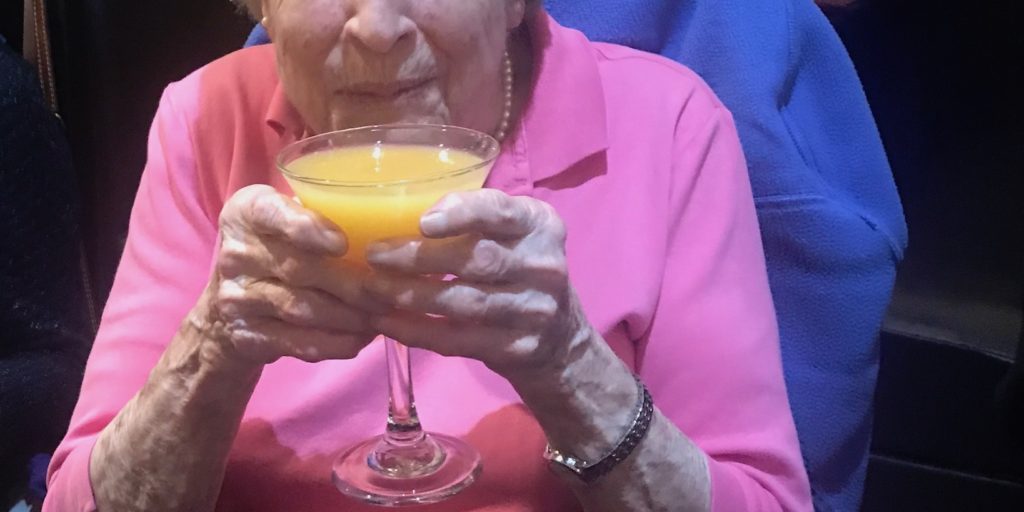
Note: This updated story was originally published at Her Stry Blog. The photo was taken at Rose’s 100th birthday party.

  • Previous
  • Page 1
  • Page 2
    • Share on Facebook (Opens in new window)Facebook
    • Share on LinkedIn (Opens in new window)LinkedIn
      © 2026 Denise Marotta Lopes. Essential Theme by SPYR
      ✕
      • Stories
        • A Mom to the Rescue
        • Everyone’s Aunt Lucy
        • Everyone’s Neighbor
        • My Dad’s New Clothes
      • Furry Friends
        • Raising Ivy
        • Raising Ivy (12 weeks)
        • Raising Ivy (4 months)
        • Raising Ivy…the saga continues

      Author Bio

      Denise Marotta Lopes

      I appreciate the little things and write about them. I desire to bring encouragement, hope,and—without exception—love.

      denisemarottalopes@gmail.com